


Cow data is pivotal to present and future success (Nov/Dec 25)

The individual-cow milk sample ‘tells all’, from herd management to cutting edge research, as ongoing on-farm and cutting-edge research in Scotland highlights.
TEXT KAREN WRIGHT

Measuring methane and monitoring progress as part of the UK dairy farms’ carbon footprint score continues to be an important focus on UK dairy units. The development of an accurate tool to help map progress will be invaluable. And it is what researchers on a project, being carried out at SRUC’s Barony Campus, based at Dumfries in southwest Scotland, hope to develop.
The college has four Green Feed instruments, which have been designed to measure methane production from cows’ burps when they visit the feeder-based device every four or five hours.
Two instruments are sited outdoors, monitoring methane emissions from cows in multispecies swards and grazing perennial ryegrass mixtures. These can be moved between grazing areas.
The other two instruments are indoors, measuring methane emissions from housed TMR-fed cows.
Methane monitoring
This work will contribute to the UK Dairy Carbon Network Project and, as part of this, methane monitoring is also being carried out at other dairy research sites including Harper Adams University, Reading University and AFBI in Northern Ireland. Each is looking at methane emissions from dairy cows on different systems and across a range of genetics.
“About 95% of a cow’s methane production is emitted from her mouth,” says SRUC’s Richard Dewhurst. “So from one or two weeks of recording emissions from individual cows through the Green Feeder we can build up a good picture of her methane production.”
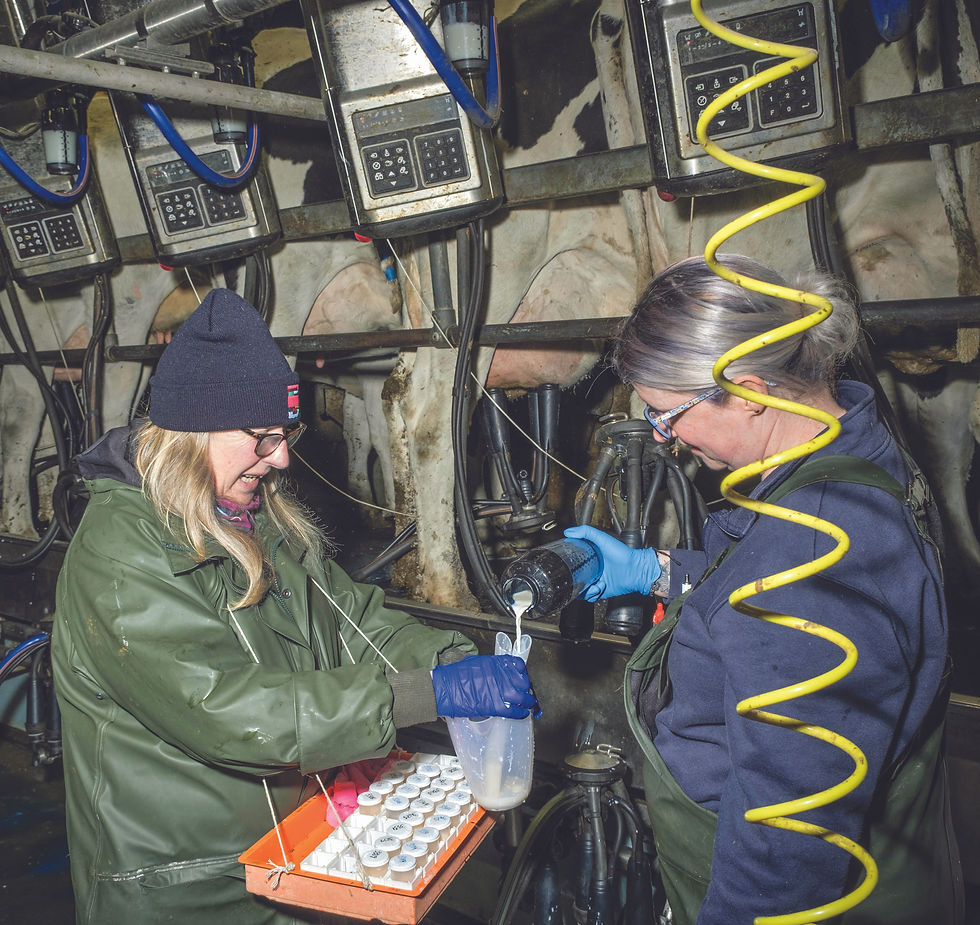
Like many Scotland-based producers who use NMR’s recording and disease-testing services, the 220-milking cows in the trial at Barony Campus are milk recorded on a monthly basis and the milk samples are tested at NMR’s national testing laboratory.
As well as the standard fat, protein and lactose results, NMR also provides SRUC, and the other research centres involved in the project, with the raw milk spectra captured through the mid InfraRed (mIR) testing process. This spectra includes 1,066 data points from the mIR image. Put simply, it gives the fingerprint of the milk from the individual cow.
The SRUC project aims to determine if this fingerprint is affected by her methane output. And, if so, to find out if there is scope to establish a proxy measurement of methane output from the milk sample and associated phenotypic information from the cow.
“We would be able to link this to genetics, diet, environment and other factors, and determine the impact of these factors and management changes in, for example, diet or the use of a methane-reducing feed product, on methane production in a range of management systems on our dairy farms,” explains Professor Dewhurst.
Accurate information
“There’s a wealth of accurate information that can be gleaned from each cow’s milk sample test, and it adds great value to our research findings,” he says. “We are building up a database on a cow-by-cow basis, and we will include some historical data on individual-cow milk analyses to strengthen the accuracy of our results.”
Relating methane measurements to individual cow data, diet, genetics and management information is the starting point to developing a tool to use on farm, where the impact of any changes on emissions can be predicted.
“Work in Canada and Europe has suggested this can be done, but we want to show this with UK diets. At SRUC we are monitoring cow methane emissions from grazed cows and from housed cows fed a TMR based on grass, maize and wholecrop silage,” says Professor Dewhurst.
“We hope this data can help us develop a tool to use on farm for reducing methane emissions by, for example, changing the diet, using a feed additive, or breeding management.
“The more methane measurements and data from milk analyses that we add to the database the more accurate this tool becomes. We’re building this information all the time and identifying correlations between milk production, feeding and genetics by taking advantage of the reliability of individual milk samples.”
The aim is that the tool will contribute towards helping the UK dairy industry hit the targets set out in the UK Dairy Roadmap. These include a 3% per annum reduction in methane emissions and reaching net zero greenhouse gas emissions by 2050.
Detailed milk sample analyses are also being used in SRUC’s energy balance research under the guidance of Mike Coffey. A tool is already available from NMR to monitor the energy balance in cows and indicate potential body condition loss, which can cause fertility issues. This is particularly valuable in early lactation cows when energy requirements peak.
It is likely that cows that suffer with energy balance issues may also be high methane emitters, as these cows are struggling to convert energy in their diet into milk and are emitting more methane as a result.
This has an application in diet formulation for milk cows, and it is an invaluable tool for nutritionists. It will allow them to modify rations and increase energy to the cow to pre-empt problems that can impact lactation performance
“We hope that on-farm management benefits could be gained from our methane work,” adds Professor Dewhurst.
NMR is already providing producers with production and health monitoring tools based on their individual-cow milk recordings. Making its innovative testing facilities and services available to today’s research projects will ensure the most relevant services and products are developed that benefit progressive producers both now and in the future, and support the efficiency and sustainability of their businesses.
Dairy Carbon Network Project is a UK-wide consortium of leading research institutions, producer-levy bodies, and industry organisations led by
the Agri-Food and Biosciences Institute (AFBI) and funded by DEFRA.
Each partner plays a crucial role in identifying, supporting, and demonstrating effective ways to cut emissions while maintaining farm productivity.
Comments