


Deep dive resolves calf-rearing niggles (June 26)

Optimax walk-through tool highlighted calf-rearing system pinch points, resolved a milk-feeding issue, and listed practical recommendations to optimise health and growth rates.
TEXT RACHAEL PORTER

After discussions with their herd vet in January, in a bid to get to the bottom of some unexplained calf deaths, during the previous few months, Somerset-based producer Craig Mounty decided to review his youngstock rearing system and setup – from calving through to weaning.
Craig runs a 360-cow herd, plus 200 followers and 450 head of dairy beef cattle, in partnership with his father Trevor and uncles Derek and Michael, at the family’s unit near Frome. Between them they have decades of experience when it comes to successful dairy herd and youngstock management. But an issue with sudden calf mortality at four weeks old triggered the start of an in-depth investigation.
“Scours can be an issue in calves up to three weeks old. E.coli may cause early issues in calves that are around 48 hours old. Crypto, rotavirus or coronavirus may then become more of an issue in calves aged between one and three weeks old. But we lost a few calves, quite suddenly and with usual symptoms, at four weeks of age,” explains Craig.
Herd vet Alex Roberts, from Wyvern Farm Vets, recommended he sent a couple for post mortem and Craig says he suspected Salmonella. But it was rumenitis (ruminal drinking), which is typically caused by issues with the milk-feeding routine. These include drinking too quickly from buckets, offering cold milk or feeding at irregular intervals.
Feeding rethink
The oesophageal groove reflex fails, milk bypasses the abomasum and ferments in the rumen, and this then produces lactic acid. The Mounty’s have always bucket-fed calves, with whole pasteurised milk and the milk is re-heated to be fed to calves twice a day. But this diagnosis demanded a rethink.
And the family agreed that it was an opportunity to take a closer look at the entire calf-rearing system, with guidance from vets Georgina Doel and James Ryder.
Georgina suggested they used a tool developed by Boehringer Ingelheim called Optimax – a Lean-management framework designed to enhance calf health and farm productivity by encouraging discussion between dairy staff and vets, and agreeing actions.
Optimax is an in-depth walk through of the existing calf rearing system and setup, drawing up a calf-health framework that allows producers and vets to review calf management from close-up dry cows to calf weaning. It encourages open discussion to identify areas of inefficiency and scope for improvement.
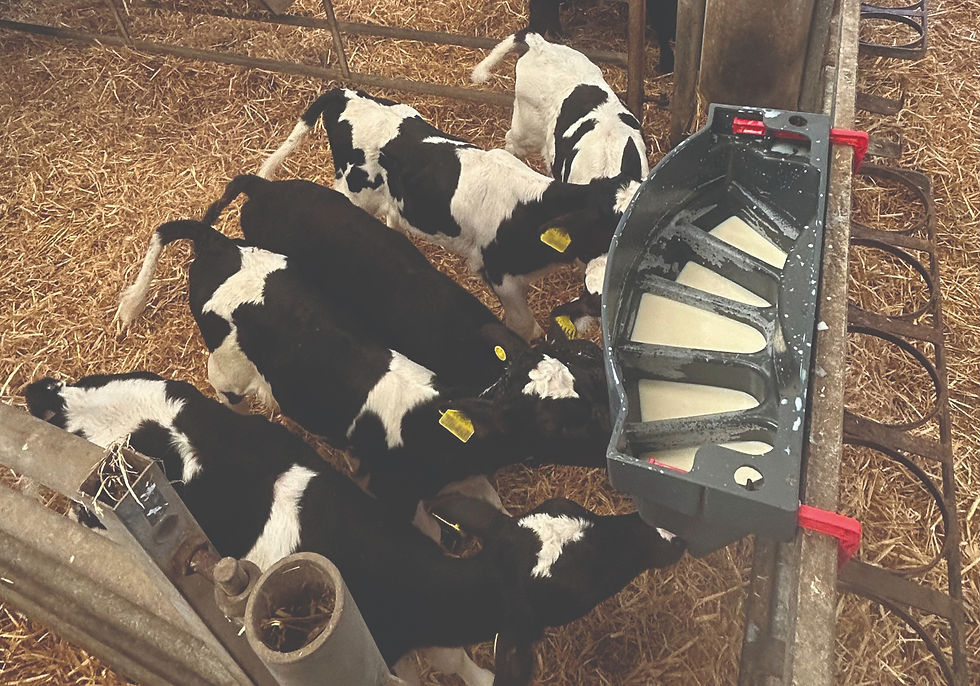
To tackle the issue of calves drinking milk too quickly, the Mounty’s invested in 30 single-teat feeders, for the 30 single pens where calves are housed until they are two or three weeks old. They also bought eight five-point feeders, for when the calves are grouped in pens of five until they are around 16 weeks old. “And we also use teats with inverted ends for these feeders, which make it harder for the calf to drink the milk quickly,” adds Craig.
Time saving
He’s pleased with the switch on many levels, not least knowing that rumenitis will no longer be an issue. “We were impressed at how quickly the calves took to drinking from the teats and we no longer have to train calves to bucket feed. So that’s saved time.
“Using teat feeders also save time when it comes to feeding calves. It’s much easier. Yes, we do spend more time cleaning the feeding equipment, but the trade-off is worth it,” he says, adding that there have been zero calf losses since the visit in January and implementing the changes.
The Optimax walk also flagged a potential colostrum management issue. Craig admits never testing colostrum for quality but has always ensured calves had four colostrum feeds in the first 48 hours of life. If they suspected colostrum was poor quality, they would add powdered colostrum to fortify it.
“We thought this guaranteed that calves would get the passive immunity required to fight off disease. But Georgina urged us to test colostrum because quality quickly tails just hours after birth,” he says.
Craig bought a Brix refractometer to test colostrum and a mobile milking unit so that colostrum could be harvested as soon as possible after birth – ideally within an hour. If taken quickly, it typically measures at between 25% and 30% on the Brix scale – which is ideal to ensure good passive transfer of immunity.
Craig says he was surprised at how quality varies from 30% within 60 minutes of birth and rapidly declines after that. “Using the refractometer really drove it home for us,” he adds. “We could see how colostrum quality ‘falls off a cliff’ after an hour, down to between 15% and 16%, which means the calves fail to get the antibodies they need. We vaccinate dams to help protect calves from Crypto, so good passive transfer via top quality colostrum is vital.
“Once we saw what was happening in terms of colostrum quality, we couldn’t ‘unsee’ it. That’s why we invested in a mobile milking unit, to speed up colostrum harvesting and ensure that it could be done easily and in that crucial early window,” he adds.
Calves still receive four feeds in the first 48 hours, and there was some confusion with poorer quality colostrum being thrown away. “This still contained the important antibodies from vaccinated dams, so we feed it for the second, third and fourth feeds but it’s fortified with a colostrum product.”
Craig is pleased with the changes to the unit’s calf rearing system and says that completing the three-hour Optimax walk, with his father Trevor, vet Georgina and her colleague James Ryder, was time well spent.
“Our setup and how we were doing things needed a fresh set of eyes across it and it also gave us the opportunity to step back and question what we were doing and why, and if we could do it better.”
“The Mounty family runs a successful and healthy dairy herd, but like all units, there are always things that can be improved – particularly when it comes to calf rearing,” adds Georgina.
Deeper level
Like many dairy businesses, they have made tweaks here and there to resolve issue as they popped up. But Optimax meant they could get back to basics and take a closer look at how the calf rearing system was being managed on day-to-day basis and resolve issues on a deeper level.
She says the three-hour walk through and discussion helped her and James to draw up an action list. “We then asked Trevor and Craig to come into the practice to talk through the pointers and how best to implement any recommendations and changes.”
The process also allows for honest discussions without judgement. The Mounty’s for example, were unaware that bucket feeding has fallen out of favour, with most herds now feeding milk via teat-base systems.
“But they’ve embraced that now,” adds Georgina. “Trevor has put his engineering skills to work and built a washing-up station for the milk feeding equipment, as well as designing a drying rack.
“And colostrum testing has also been a game changer. It’s taken the guesswork out of ensuring good passive immunity to calves and also ensures that vaccinating dams against diseases such as Crypto is fully effective.”
Comments