


Water – the powerhouse in calf performance (Oct 26)

Calves consume more water, by volume, than any other nutrient from birth and it’s vital for all physiological functions. But do we give it enough attention? Delegates at this year’s National Youngstock Conference found out.
TEXT KAREN WRIGHT

Water makes up around 85% by volume of milk replacer fed to calves but calves should also be drinking increasing amounts of free water, which should be available from day one.
So said Cargill’s Bianca Theeruth, who spoke at this summer’s National Youngstock Conference about the important role that water has to play in all physiological functions.
“While we scrutinise each ingredient in calf milk replacers, such as the fatty acid profile and amino acids in proteins, little attention is given to the water that is used to mix the replacer,” she said, adding that water quality determines how the ingredients in the calf milk replacer works.
Free water, which should be fed to calves from day one, drives rumen development and also influences nutrient utilisation. No metabolic functions can work without water.
Water quality will determine the end feed value. Water hardness and mineral interactions affect stability, digestive consistency and palatability. And the water pH and total dissolved solids (TDS) affect nutrient behaviour. Microbial contamination, bacterial load and biofilm will also affect performance. Temperature influences mixing efficiency and intakes of milk replacer.
Different pathways
Highlighting the vital role of water in the calf’s diet from the start, Ms Theeruth pointed out that water in milk replacers and free water, drunk from a bucket, follow different pathways. The two sources of water enter different stomach compartments.
Water intake, as part of the milk replacer, bypasses the rumen via the oesophageal grove and is digested by enzymes and acids in the abomasum. The nutrients are absorbed in the small intestine to support growth and maintenance.
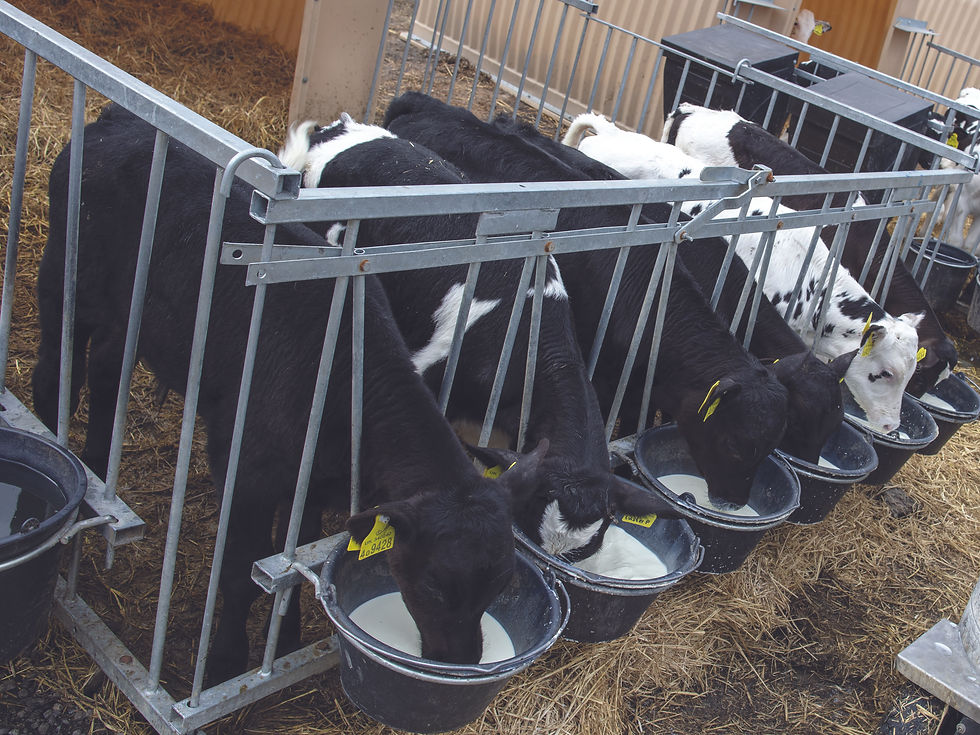
Meanwhile free-access water enters the rumen and supports the microbial population and fermentation which, in turn, promotes volatile fatty acid production and stimulates rumen growth. Access to free water from day one will therefore accelerate rumen development and improve nutrient utilisation in starter feeds.
Research shows that early access to free water increases starter intake and helps rumen development. This enhances growth rates and feed efficiency and supports smoother weaning transitions.
The results from trials investigating the impact of water intake on young calf growth has shown that calves given ad-lib calf starter and water from day one had significantly higher growth rates at four weeks old, improved starter feed intakes and fewer cases of scours compared with calves receiving no free water. Weight gain was reduced by 38% and starter feed intake by 31% for calves deprived of water.
“This is why we need to correct the belief that calves don’t need access to free water because they get their water from milk,” stressed Ms Theeruth.
Water quality
“When we add water to milk replacer, the end feed will vary despite the fixed formulation of the milk powder,” she added. “This is because the microbial quality and mineral chemistry of the water vary, and can affect fat emulsification, protein stability, digestive consistency and nutrient uptake. Temperature will also affect how feed ingredients in the milk powder behave.”
Calves fed whole milk are less prone to variability in water quality compared with those fed on milk replacer, because as the mammary gland has the ability to take care of this. “Both are good sources of nutrients,” she said. “But the cow acts as a biological filter, and the mammary gland has the in-built ability to manage the variability of nutrients in water. It can assimilate the variation in the milk and ensure a consistent product for the calf. We want to ensure this same consistency in diets fed to calves fed on milk replacer, and in the free water they drink.”
Hard versus soft water and whey versus skim milk powder will influence milk powder interactions. “So select the one best for your unit,” added Ms Theeruth. “Beware of things like sedimentation, foam formulation and altered consistency.”
Testing water at source and at the point of consumption or use are recommended. Water quality may encounter seasonal variations, particularly if taken from bore holes.
And even if water comes in ‘perfect’, it may become contaminated in pipework or troughs, where bacteria can build up or biofilms can form, or in mixing systems. “We shouldn’t leave calves to cope with the bacteria,” stressed Ms Theeruth.
Routine testing
Estimates suggest that only between 5% and 10% of producers test water routinely, and many do this at source rather than where it’s being consumed. But the latter is the most important. Taking precautionary action is encouraged as part of good water management.
Ensuring that consistently high-quality water is available to calves will promote performance and feed efficiency from day one and reduce disease pressure and antimicrobial reliance.
“Calves need water to maximise the nutritional potential of their diets. It is an active nutritional component rather than a passive carrier of other nutrients,” said Ms Theeruth. “Water quality and provision must be, therefore, as precise as the diet itself. It’s one of the least controlled variables in calf production, but it should be evaluated with the same rigour as feed inputs.”
Comments